

A SNAP-shot Series of Challenging Wounds Made Easy in Breast Surgery: Case 1- Managing Complications in Oncoplastic Breast Surgery
Chi Wei Mok1-3,Yen Nee Sophia Chua1*, Jun Xian Jeffrey Hing1-3, Su-Ming Tan1-3
*On behalf of Changi General Hospital Breast Centre Breast Care Nurses (BCN): Thai Wei Li, Lim Chii Kiang Serene, Tang Ping Sing, Norhidayati Binte Mohd Noor, Christine Joy Manuel, Siti Hajar Binte Mat Nadar
Correspondence to:
Clin Asst Prof Chi Wei Mok
Division of Breast Surgery, Department of Surgery, Changi General Hospital, Singapore.
Singhealth Duke-NUS Breast Centre
Email: [email protected]
ABSTRACT
Oncoplastic breast surgery has become an integral part of the surgical management of breast cancer. The use of an aesthetic approach to breast conservation or mastectomy greatly enhances the range of options that can be offered to women with breast cancer and facilitates better outcomes from it. However, the risks of wound complications as a result of oncoplastic procedures are higher if compared to conventional surgical options. The implication from any possible complications would be delay in adjuvant therapy for patients which may inevitably compromise on the oncological outcomes and prognosis of patients in the long run. Ideally, adjuvant therapy should be commenced within 3 months from the date of surgery.
In certain cases, management of wounds with conventional dressing may take up to 3 months and this is suboptimal for the oncological treatment of patient. In this case study, we present a case of wound necrosis post debridement which was successfully managed with SNAP therapy system.
SNAP therapy system is a valuable addition to the wound management armamentarium in breast surgery, especially in oncoplastic breast surgery whereby a reduction in wound healing and complications would cast an indirect benefit in the overall prognostication of patients who require adjuvant therapy after oncological resection.
INTRODUCTION
This case study described a 60 years old lady with a body mass index (BMI) of 37.8 who was diagnosed with bilateral breast cancer and underwent bilateral Goldilocks mastectomy with lateral intercostal artery perforator (LiCAP) flap reconstruction in April 2021. Her past medical history includes that of well controlled diabetes mellitus and hypertension.
The operation went on uneventfully and patient was discharged well 1 day after surgery. However, on her routine outpatient clinic visits for wound inspection and dressing, she was noted to have partial flap necrosis over the tip (medial aspect) of her flap reconstruction on the left side (Figure 1a and 1b). A wound debridement was performed early in her post-operative period (POD 14) and resulted in a wound measuring 6 (length) x 2 (width) x 3 (depth) cm (Figure 2). Wound bed was slightly sloughy with moderate amount of necrotic fat tissue.
As her final histopathology returned as a Stage 3 (TNM), she would require adjuvant therapy in the form of chemotherapy, radiotherapy and endocrine therapy. In order not to delay her adjuvant therapy which would inevitably affect her eventual prognosis, expedient wound healing would be a crucial step in her cancer treatment.
Conventional dressing along with an expectant management would lead to eventual recovery, albeit a slow one with healing ranging from 2-3 months or even longer. This was unacceptable to the managing team as the time of adjuvant therapy would preferable be within the first 3 months after surgery.
SNAP Therapy System was chosen as the planned wound therapy as both patient and managing physician preferred a mobile device in order not to limit patient’s movement. In addition, a negative pressure wound therapy (NPWT) system would accelerate the healing process and granulation of the wound.
METHODS
The SNAP therapy was initially planned for 2 weeks (4 canister change). All applications were done in the outpatient clinic mainly by breast care nurses certified to perform NPWT. At every dressing change, wound was debrided to ensure clean healthy granulation tissue before application of SNAP therapy system. Wound edges were lined with Brava® Strip Paste (Coloplast). The Brava® Strip Paste created a tight seal between the wound edges and the baseplate. This also helped avoid leakage, absorb moisture and improve the skin condition around the wound. The hydrocolloid stick pad was then applied to the breast without need for additional barrier dressing application. Each dressing change (including wound debridement) was performed under 10 minutes by a single breast care nurse with or without supervision and minimal assistance from the attending physician. A 60ml canister was used with preset negative pressure of 125mmHg. The patient tolerated each dressing and SNAP therapy change well.
RESULTS
Patient eventually underwent a total of 6 SNAP therapy systems change (3 weeks). Her wound progressed exceptionally well with progressive granulation and contraction of the wound (Figure 3 and 4). There was no to minimal debridement required at every dressing change. In addition, other than her first dressing change where the SNAP therapy system was full with 70ml of wound exudate, the remaining dressing change yielded minimal exudate. At the conclusion of 6 weeks, the wound was filled with healthy granulation tissue and patient was subsequently placed on simple dressing to allow epithelization. Her wound eventually healed 1 month after the start of SNAP therapy system and adjuvant chemotherapy was successfully commenced at 8 weeks after her surgery.
FIGURES
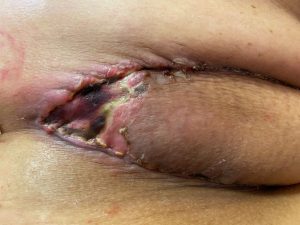 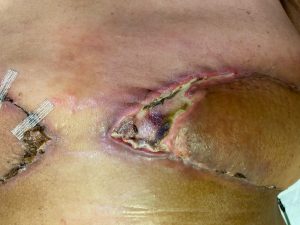 |
| Figure 1(a) and 1(b): Wound at baseline (POD 7)(1a) and (POD 14)(1b) before debridement |
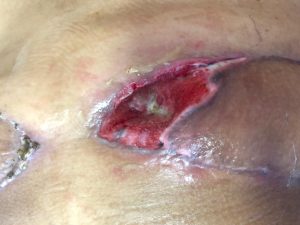 |
| Figure 2: Wound after debridement and application of first SNAP therapy |
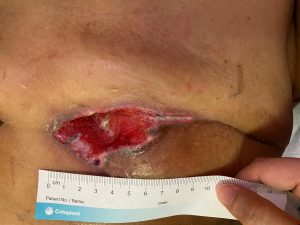 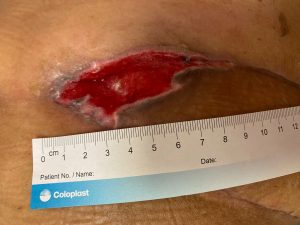 |
| Figure 3a and 3b: Wound showing progressive healthy granulation tissue with reduction of wound depth after 3rd (3a) and 4th (3b) SNAP therapy |
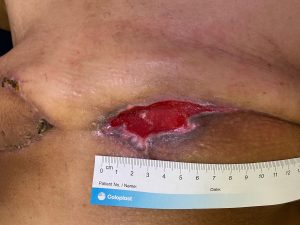 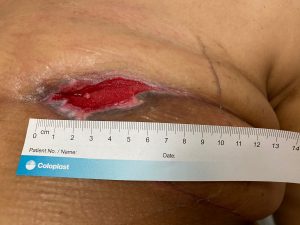 |
| Figure 4a and 4b: Wound condition after 5th (4a) and 6th (4b) SNAP therapy |
DISCUSSION
Surgical site infections (SSI) or wound necrosis are common yet significant complications in breast surgery, be it reconstructive or non-reconstructive surgery1. This complication can often lead to prolonged hospitalization, which increases the cost of treatment. In a cost analysis performed by Olsen et al2 in 2006 whereby the authors evaluated the hospital associated costs due to surgical site infection after breast surgery, it was reported that patients with SSI had a crude median cost of USD 16 882 compared with USD 6123 for uninfected patients. Most of the incurred costs were attributed to prolonged hospitalization stay, readmission, additional operative debridement as well as antibiotics treatment. SSI definitely poses a significant economic burden to all stakeholders in healthcare, be it patients, care providers or hospital.
In a comparative cohort study looking at difficult-to-treat lower extremity ulcers published in 2010 by Lerman et al3, the Kaplan–Meier estimates showed that the SNAP group demonstrated a shorter healing duration time (mean 74.25 ± 20.1 days versus 148.73 ± 63.1 days, P < 0.0001) if compared to modern wound care protocols (comprising of Apligraf, Regranex, and skin grafting), which also represents a 50% reduction in absolute healing time with the SNAP system. In another randomized controlled trial comparing SNAP and conventional V.A.C system by Marston et al4 in 2015, there was an interesting observation towards reduced risks of allergic reaction, pain, and wound infection in the SNAP group, which is likely a result of the protective effect of hydrocolloid dressing used in this system.
Results from these studies were encouraging as a shorter healing time with lesser wound complications would inevitably result in overall cost savings and economic burden. If compared to the cost of SNAP therapy system, the only cost analysis study performed by Hutton et al5 in 2011 showed that the SNAP system saved USD $2800 for private payers and $2300 in Medicare payments per treated wound compared with conventional wound care. To put this case study into perspectives, the cost of a 3-week (6 SNAP canisters change) regime in the authors’ institution would have costed the patient USD $940 (SGD $1274). Based on cost considerations alone, SNAP therapy system is definitely encouraging but it definitely warrants further cost effectiveness analysis on a larger group of patients.
Aside to cost savings, there was a definite advantage of utilizing SNAP therapy system in this case as the reduction in wound healing time and complications would also translate into earlier commencement of adjuvant therapy for this patient. This was an important consideration from the oncological standpoint.
From the authors’ experience in managing challenging breast wounds with SNAP therapy system, it stands out from other products or systems with its portability and ease of use. In addition, it is also quiet and easy to apply. For this case study, SNAP was suitable as it was a low exudate and clean wound.
To complement the widespread utilization of SNAP therapy systems, fundamental support in the form of trained and certified breast care nurses are an integral part of a strong and versatile wound team managing patients with challenging breast wounds and the authors firmly believe that this is one of the strengths of the institution in this aspect. The disadvantages or slight drawback would be the need for training as well as the unsuitability of the system for larger wounds.
CONCLUSION
In conclusion, SNAP therapy system is a valuable addition to the wound management armamentarium in breast surgery, especially in oncoplastic breast surgery whereby a reduction in wound healing and complications would cast an indirect benefit in the overall prognostication of patients who require adjuvant therapy after oncological resection.
Acknowledgement
We would like to thank the support of all the Breast care nurses – Thai Wei Li, Lim Chii Kiang Serene, Tang Ping Sing, Norhidayati Binte Mohd Noor, Christine Joy Manuel, Siti Hajar Binte Mat Nadar at Changi General Hospital Breast Centre for facilitating the care for this patient.
Disclosure
No conflict of interest to declare.
Patient anonymity has been maintained.
The case study submitted to this competition has not been published or submitted elsewhere.
References